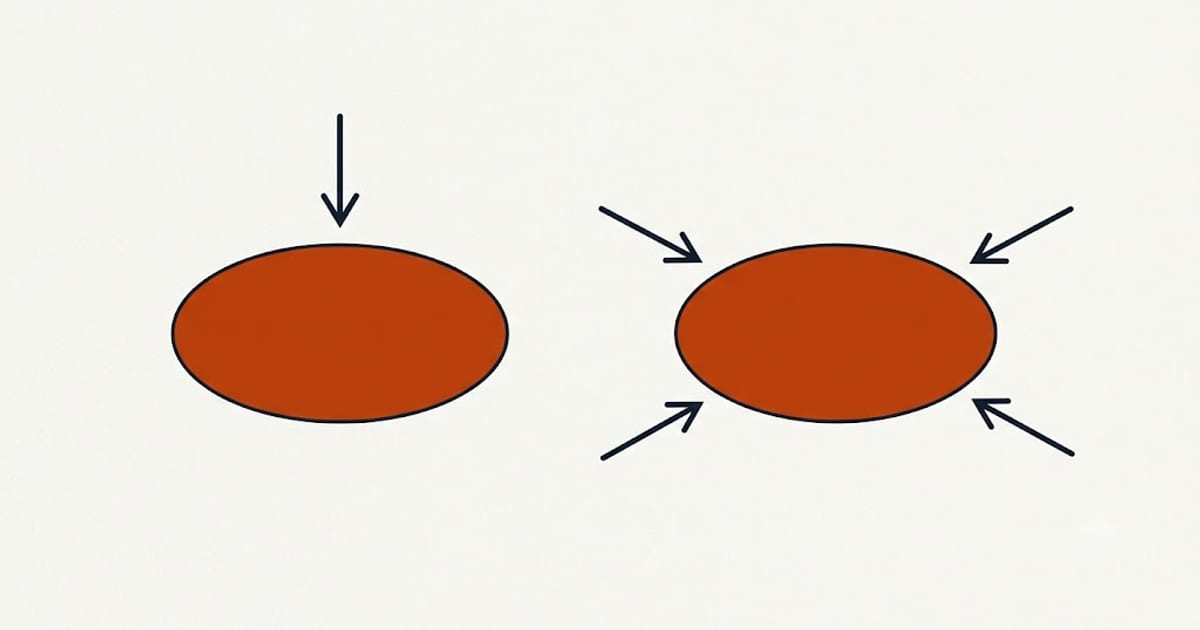
Most bathrooms have one light in the middle of the ceiling. It illuminates the room and it is the wrong light for the one task the room is used for.
Why overhead light is unflattering
Light from directly above casts shadows downward — into the eye sockets, under the nose, under the chin. That is the lighting used deliberately in films to make someone look unwell.
For shaving, applying makeup, or simply looking at your own face, light needs to arrive at face height, from both sides.
The three layers
Task lighting at the mirror. Sconces either side at roughly eye level, about 36 to 40 inches apart, or a vertical fixture on each side. This is the layer that matters most and the one most often missing.
A single light bar above the mirror is better than a ceiling light and still casts downward shadows. Two side lights beat one top light.
Ambient lighting. A ceiling fixture or recessed lights for general illumination. This is what most bathrooms have as their only layer.
Accent or night lighting. A low-level light for use at night that does not require the main lights, which matters more than it sounds in a house with children or anyone getting up in the night.
Colour temperature and rendering
2700K to 3000K reads as warm and matches most household lighting. 3500K to 4000K is neutral and is closer to daylight for makeup application.
Mixing temperatures in one room looks wrong. Pick one and use it for every fixture including the shower light.
CRI above 90 matters here more than anywhere else in the house. Colour rendering is what decides whether makeup applied in the bathroom looks right in daylight, and low-CRI light is the common cause of that complaint.
In the shower
A damp-rated or wet-rated fixture depending on its position — wet-rated where it can be directly hit by water. This is a code requirement rather than a preference.
A shower is a small dark box and the ceiling light rarely reaches into it usefully. A dedicated shower light makes a noticeable difference and is one of the cheaper improvements.
Dimming
A bathroom is used at very different times for very different things. A light level appropriate for shaving at 7am is unwelcome at midnight.
Dimmers on the ambient and task circuits cost little at rough-in and require compatible fixtures — LED dimming compatibility is worth checking rather than assuming.
Circuits and switches
Plan the switching at rough-in: which fixtures are on which switch, whether the fan is separate, and whether a humidity sensor or timer controls it.
A common and sensible arrangement is vanity lights on one switch, ceiling and shower on another, and the fan on a timer or humidity sensor independently.
Where the fan and the light share a switch, the fan runs only while the light is on, which is exactly not what is wanted after a shower.
GFCI
Receptacles in a bathroom require GFCI protection, and the requirement is not optional. A remodel is the moment this gets brought up to current standards, and it is an inspection item.
Adding a receptacle inside the vanity, for a shaver or a toothbrush charger, is a small addition at rough-in that removes clutter permanently.
Mirror choice interacts with lighting
A backlit or edge-lit mirror provides some of the side light a sconce would, and in a narrow bathroom where there is no wall space beside the mirror it is often the only practical way to get light at face height.
It is not a complete substitute — the light is behind the face rather than on it — but combined with a modest ceiling fixture it is far better than an overhead downlight alone.
Where wall space exists, two sconces still win.
Retrofitting into an existing bathroom
Adding sconces means opening the wall beside the mirror, which on a tiled wall is a repair that will show. Where the wall is not tiled, it is a straightforward addition.
That asymmetry is the reason to decide lighting during a remodel rather than afterwards, and it is one of the cheapest decisions to get right at rough-in and one of the most expensive to change later.